Woman And computer
Human And Computer
Showing posts with label Physics. Show all posts

The Cosmic Neutrino Background

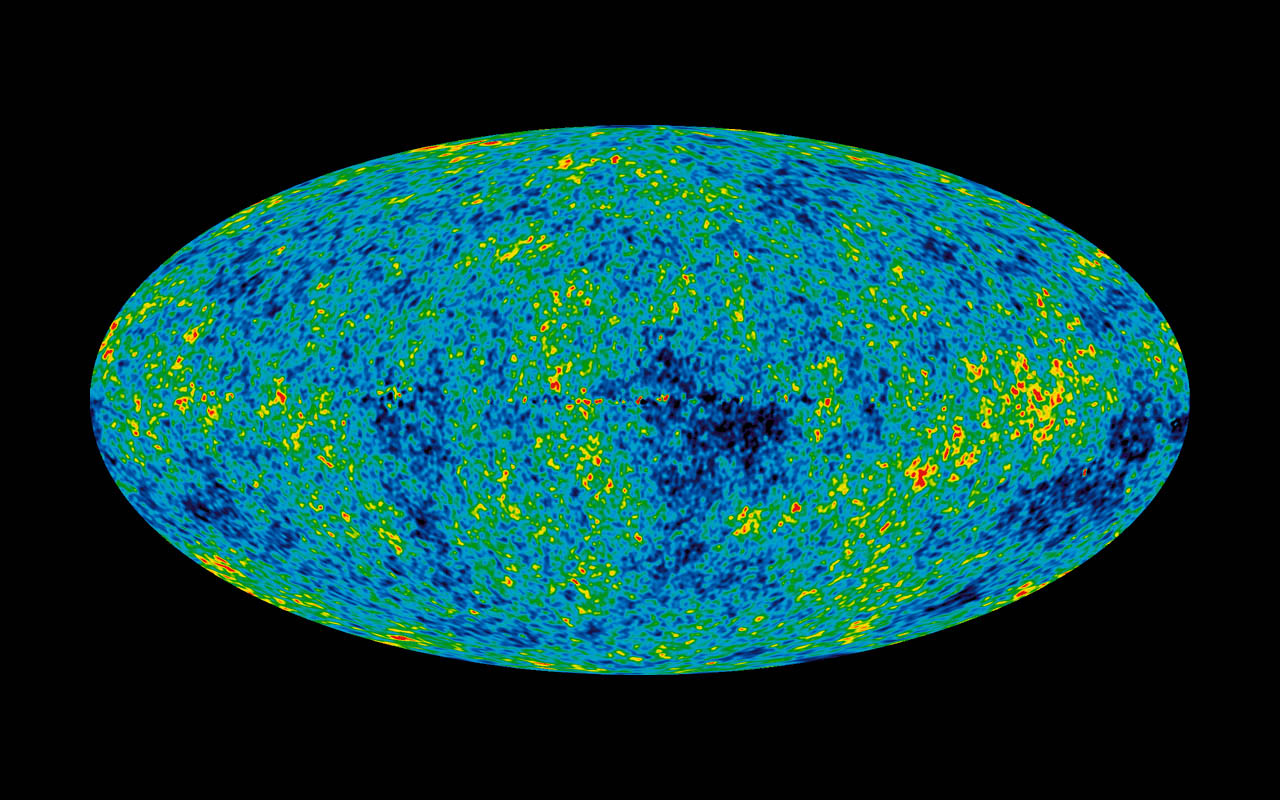
In the very early universe matter was dense and hot. With the expansion of space, matter cooled down which eventually allowed for the formation of nuclei and later atoms, molecules and increasingly large structures. Atoms could be formed when the average energy of electrons decreased to a value so small that ionization became improbable - an event called recombination. Photons, which prior to recombination were scattered on the free electrons, could then travel almost undisturbed. This happened at a temperature of about 1 eV, or some thousand Kelvin. Due to the continuing expansion of the universe, the photons from that time became redshifted, but are still present today. Their temperature is now at 2.7 K, and they have become famous under the name Cosmic Microwave Background (CMB). The temperature fluctuations in the CMB carry information about the structure of matter at the time of the photons' decoupling from matter. WMAP has measured these temperature fluctuations with great accuracy. (We discussed the CMB and some of what we have learned from it here, here, here and most recently here.)

The photons that we are so used to rely on for "looking" do not allow us to learn anything about the early universe prior to recombination. But we can try to see by other means. Neutrinos are well known for being weakly interacting, which is why they are so difficult to detect. But that they interact only weakly also means neutrinos ceased to scatter on the hot matter in the early universe earlier than photons. This happens at the typical energy scale for the weak interaction, at about 1 MeV or 1010K, after which the scattering of neutrinos and anti-neutrinos to produce an electron-positron pair became very improbable and, briefly after this, nucleosynthesis took place. Today, the temperature of the cosmic neutrino background, C?B, is about 10-4 eV or 2 Kelvin* and it's all around us.

While we have not yet measured the absolute neutrino masses, but only have upper bounds, neutrino oscillations test for the differences of squares of masses. This allows us to conclude that at least some of the neutrino species must have cooled so much that their kinetic energy is smaller than their restmass, which means they are non-relativistic. This is interesting because these neutrinos will then clump in gravitational fields like that of our Milky way. As a consequence, the density of neutrinos on the path of planet Earth is roughly one to two orders of magnitude larger than the average density.

Still, these C?B neutrinos are very difficult to detect. But difficult is not impossible. Neutrino capture on tritium would, with some effort but presently available technology, yield a detection rate of maybe 10 C?B neutrinos per year [reference]. That would be enough to confirm the presence of the C?B, but to measure temperature fluctuations, with that procedure we'd probably have spend some million years doing nothing but gathering statistics, not to mention that tritium doesn't grow on trees. Alternative to tritium, it has recently been proposed to instead capture anti-neutrinos on Holmium, which, with some effort and some luck, might yield comparable detection rates. Direct detection of the C?B is the first step. Since the detection rate depends on the neutrino-density, it would not only confirm our theories about the creation of the neutrino-background, but give us information about the distribution of neutrinos in the gravitational field of our galaxy.


Sure, there's only so much you can learn from 10 neutrinos per year. But who knows what technological progress will bring? Half a century ago, the precision with which WMAP measured tiny fluctuations in a temperature that is tiny to begin with would have seemed a fantasy. Today it's fact. So here I am telling you that the C?B is out there, waiting for us to harvest the information it contains.


* It is (4/11)1/3 times the temperature of the CMB. The conversion factor is partly due to neutrinos being fermions while photons are bosons, and partly due to the photons gaining in density, and thus temperature, when electron-positron pairs annihilate to photons while the opposite reaction becomes increasingly improbable. When this happened, neutrinos had already decoupled.

Book review: "A Brilliant Darkness" by Jo�o Magueijo

Labels: ,

A Brilliant Darkness
The Extraordinary Life and Mysterious Disappearance of Ettore Majorana, the Troubled Genius of the Nuclear Age

Jo�o Magueijo
Basic Books (November 24, 2009)

The Italian theoretical physicist Ettore Majorana disappeared in 1938 at the age of 31. The reason for his disappearance and what happened afterwards were never clarified. His fate has inspired many books and movies, most of Italian origin, of which I haven't read or seen a single one. Thus, Magueijo's book was the first time I heard about the various theories of Majorana's disappearance, the leading ones being suicide, joining a monastery, or starting a new life in Argentina, due to depression, insanity, homosexuality or moral trouble with a research direction that Majorana might have understood earlier than everyone else would lead to the atomic bomb.

"... the [atomic] bomb, so much like a star in the sky, but so close to us that its brilliance amounted to darkness."

The more obscure theories feature various conspiracies, special forces, and/or aliens.

Jo�o's book, instead of listing all these theories, is a report on his following up on Majorana's fate. He has interviewed friends and relatives, seen the movies, read the books, visited the places. Woven together with his travels are explanations of the physics Majorana has been working on and the historical circumstances. The physics is explained on a level understandable without previous knowledge and covers atomic physics, �-decay, parity, chirality, neutrino-oscillation, (neutrinoless) double �-decay and the experiments behind all this. The reader is confronted with the difficulties scientific research had to cope with under Mussolini and Hitler, and gets to meet Majorana's contemporaries, among others Fermi, Heisenberg, Dirac and some radioactively contaminated fish.

Jo�o does not put forward his own theory or presents a solution to the mystery. Instead, he uses Majorana's life and unknown fate to get across some science and touch upon questions like the role of scientists in our societies, the clash between pragmatism and idealism, the ignorance of academics, the balance between competition and collaboration, and the influence of personal life on ones research. There's a lot in that book to make you think and Jo�o doesn't even attempt to think in your place.

The book is well written in a light-hearted style despite the dark topic, and the main flavor is sarcasm. Jo�o, let me remind you, is the one who famously suggested in his first book that the "M" in M-theory stands for "masturbation." In his book on Majorana, string theory makes an appearance as as an example for "the fad of postulating thousands of unnecessary particles," and Jo�o doesn't hesitate to speak his mind on all and everybody: Fermi, so Jo�o writes, "did lack imagination," "when [Dirac] spoke the outcome was... logically crafted insanity," and Cambridge (UK) is "that ivory tower of lunacy." The book is also interspersed with paragraphs that seem to have gotten there by random association, my favorite one is:
"Saying that we live in an odd world is often an understatement. I once had a random conversation on a Toronto street that derailed into the most sublime insanity. After a few minutes of pleasant platitudes, my casual acquaintance, out of the blue, revealed that "they" had implanted radioactive isotopes in his testicles. Being high-minded, he refrained from ejaculating, lest he might contaminate the entire universe."
and later he describes meeting an old friend at a book fair in Buenos Aires, an event that doesn't have any apparent relevance to Majorana's story. There's more side-tracks of this sort. One might say the book is also a book about Jo�o. If you decide to read it, you'll either love or hate it, but either way you'll very likely finish reading it.

Book review: �The Shape of Inner Space� by Yau and Nadis

Labels: ,

The Shape of Inner Space: String Theory and the Geometry of the Universe's Hidden Dimensions
Shing-Tung Yau and Steve Nadis


Yes, I said I have no intentions reading the book. But then I was offered a copy for free. And, since I had it anyway, I could as well read it, no?

�The Shape of Inner Space� is a curious mixture of Yau�s autobiography, a crash-course in differential geometry, and physics-themed popular science, sandwiched between an introduction to the history of geometry and philosophical considerations about the beauty of mathematical truth. The string that runs through the book and weaves it together are Calabi-Yau manifolds. Shing-Tung Yau, the �Yau� in �Calabi-Yau,� has spent pretty much his whole life on these manifolds and won the Fields Medal in 1982, among other achievements, for his proof of the Calabi conjecture. So the reader learns first hand from the world expert. Steve Nadis is a popular science writer, and the two have joined forces to produce the book.

The result is interesting and also courageous.

After the introduction, it follows a brief history of geometry. From Pythagoras and Plato over Euclid, Descartes, Gauss and Euler to Minkowski, Riemann, Einstein, Kaluza, Klein and, of course, Calabi. As we come closer to the 21st century, we learn about the geometrization of physics and its successes. To move on beyond Platonic solids, the reader is introduced to mathematical lingo in a rapid fire treatment. It starts with the innocent concept of derivative and integrals. From there it goes on to partial derivatives, curve integrals, non-linear partial differential equations, manifolds (differentiable, compact, orientable, product of), complex numbers, metric (in n dimensions, hermitian), parallel transport, geodesics, curvature and Ricci curvature, groups, tangent spaces, fibre bundles, exotic spheres, homeomorphic diffeomorphisms, harmonic equations, Betti numbers, Chern classes, holonomy and cohomology, Ricci flow, Riemann surfaces, K�hler manifolds and of course Calabi-Yau spaces. Just to mention a few. If you're afraid of math, this book is not for you.

In the later chapters follow the contemporary topics, and the connection to string theory is established. The reader learns about the Dirac equation, Yang-Mills theory, mirror symmetry and the Seiberg-Witten equations. We come across Yukawa-couplings, correlation functions, black hole information loss, moduli and the landscape problem. We meet familiar names like Hawking, Penrose, Guth, Strominger, Kachru, Witten, Greene, Gross, Susskind, Vafa, Giddings and more. Nadis has interviewed many researchers in the field and the text is frequently supplemented by quotations from these interviews (and other sources). One might find it an expression of laziness (or maybe cowardice) to export explanations and opinions into quotations from other people. But I found it very readable and interesting to hear the researchers� comments and explanations of their work, and that of others, in their own words. I liked that a lot.

The mathematical and physical explanations are accomplished basically without equations (though there are a few examples) and without formal definitions. Sometimes the text is accompanied by figures that I found very helpful and well done, but figures only get you so far to understanding six dimensional spaces. Now all the used concepts are explained somewhere, and I was familiar with most of the terminology before reading the book anyway. But I suspect if you don�t know anything about field theory, differential geometry, and topology, �The Shape of Inner Space� is a very heavy read.

With use of the introduced mathematical concepts the reader then learns what Yau proved, what his colleagues proved and how the field has evolved within the last some decades. Then the authors explain how the connection to string theory came about and how this intersection of physics and math has been fruitful for both sides. That I found indeed the most interesting aspect of the book: The interrelation between mathematics and physics and the mutual benefit for both sides. Yau writes:

�[I] like to position myself at the interface between these two fields, math and physics, where a lot of interesting cross-pollination occurs. I�ve hovered around that fertile zone since the 1970s and have managed to get wind of many intriguing developments as a result.�

However, the book is very focused specifically on the cross-pollination between differential and algebraic geometry and string theory that has sprung from Calabi-Yau spaces. It is a pity there was not more about the recent and not-so-recent history of the math-physics exchange in a broader sense.

Towards the end of the book, after a somewhat bizarre interlude about the way you would die through false vacuum decay, we then find a chapter on experimental tests of string theory. Yau is a mathematician and takes the point of view of an interested outsider. His main interest is mathematical truth, and if physicists with their methods can help mathematicians discover previously unknown relationships, then what does it matter if the physics eventually turns out to be a description of reality? But one or the other reader might care.
�At the end of Dorothy�s adventures in the Land of Oz, she learned that she had the powers to get back home all along. After some decades of exploring the Land of Calabi-Yau, string theorists and their math colleagues (even those equipped with the penetrating powers of geometric analysis) are finding it hard to get back home � to the realm of everyday physics (aka the Standard Model) � and, from there, to the physics that we know must lie beyond. If only it were as easy as closing our eyes, tapping our heels together, and saying �There�s no place like home.� But then we�d miss out on all the fun.�

Thus, in the chapter �Back to the real world� we learn about possibilities to test string theory in the early universe, by bubble collisions and their relics, by cosmic strings or � in the case of large extra dimensions � at the LHC. (I guess this is pretty much the last time a popular science book will talk about the latter possibility.)

Unfortunately, it is not very clearly pointed out that all these tests are tests not of string theory itself but of string theory inspired phenomenological models. Finding such evidence would certainly be a boost for string theorists, but not finding it doesn�t need to bother them either. A quotation by McAllister states it very carefully correct: �It�s possible that string theory will predict a finite class of models, none of which are consistent with the observed properties of the early universe, in which case we could say the theory is excluded by observation.� Yes, it is possible. But at the moment it seems like there�s a string theory motivated model to explain whatever the data will be.

Yau and Nadis avoid commenting on the controversy about the usefulness of string theory as a description of reality. On the landscape problem Yau writes �It�s fair to say that things have gotten a little heated. I haven�t really participated in this debate, which may be one of the luxuries of being a mathematician. I don�t have to get torn up about the stuff that threatens to tear up the physics community.�

�Critical treatments of [string theory], such as The Trouble with Physics and Not Even Wrong are mentioned in the passing, decorated with quotations from Henry Tye saying �string theory is too beautiful, rich, creative, and subtle not to be used by nature,� and Michael Atiyah letting us know that �even if we can�t measure it experimentally, [string theory] appears to have a very rich� mathematical structure. [String theorists] are onto something, obviously. Whether that something is what God�s created for the universe remains to be seen. But if He didn�t do it for the universe, it must have been for something.� (Like, maybe the multiverse?)

It then follows some elaboration on beauty and mathematical truth, and its relevance for physics:
�Of course, if beauty is going to guide us in any way [�] that leaves the problem of trying to define it [�] There�s no doubt that a blind adherence to mathematical beauty could lead us astray, and even when it does point us in the right direction, beauty alone can never carry us all the way to the goal line. Eventually, it has to be backed up by something [�] more substantial, or our theories will never go beyond the level of informed speculation, no matter how well motivated and plausible that speculation may be.�

But Yau and Nadis remove themselves from the debate about physical relevance by focusing on the mathematics:
�Whereas the final proof in physics is in experiment, that is not the case in math� If the mathematics associated with string theory is solid and has been rigorously proven, then it will stand regardless of whether we live in a ten-dimensional universe made of strings or branes.�

And that is what the book is about � it�s a book about the mathematics of Calabi-Yau spaces, not more and not less. Just so you know what to expect should you consider buying �The Shape of Inner Space:� It�s not, in the first line, a book about string theory and certainly not about quantum gravity*. It is a book about a special kind of manifold and the interaction between physicists and mathematicians it has brought.

The book is generally well written, though I found the writing style over long stretches somewhat uninspired. Many pages it goes along the lines that soandso wrote this paper on this, and then soandso wrote a paper on that, and then a student of soandso wrote a paper on this and that, and so on. Also, I found it somewhat disturbing that in several places technical terms are used that are only introduced in later chapters, sometimes with, sometimes without, mentioning of the later explanation (metric and entropy for example). The book has a glossary, but if hadn�t known anyway what they were talking about I�d have found it a quite annoying break in the reading flow.

The book is also discontinuous in the level of explanation. Over many pages it reads almost like a review paper on Calabi-Yau spaces, summarizing who proved what when by which method. And then there comes the occasional pop-sci explanation. Just to give you an impression, here�s a quotation from a randomly chosen page (133):
�The presence of those [covariantly constant] spinors helps ensure the supersymmetry of the manifolds in question, and the demand for supersymmetry of the right sort is what pointed Strominger and Candelas to SU(3) holonomy in the first place. SU(3), in turn, is the holonomy group associated with compact, K�hler manifolds with a vanishing first Chern class and zero Ricci curvature.�

(That supersymmetry partners bosons and fermions is btw explained only some pages later.) The level of the pop sci explanations are for example that of an exchange particle mediating an interaction by the common analogy to a ball being thrown, or for quantum foam by analogy to the British railway. (�The geometry, in other words, would be undergoing shifts so violently it hardly makes sense to call it geometry. It would be like a rail system where the tracks shrink, lengthen, and curve at will �a system that would never deliver you to the right destination and, even worse, would get you there at the wrong time.�).

The impression I had was that Yau wrote a draft, and Nadis then sprinkled pop sci explanations and quotations on it.

Taken together, I enjoyed reading the book more than expected. It is a very comprehensive summary of research I have a peripheral interest in, and Yau and Nadis have presented it very nicely, so I learned some relations that previously hadn't been clear to me. I was surprised though that the AdS/CFT correspondence is only briefly mentioned and its recent applications are not discussed at all. I'd have found it relevant to the question of what string theory is a theory of. And, there's no explanation of what is actually plotted in the omnipresent pictures of Calabi-Yau spaces you find for illustration all over the place.

Reading the book I couldn't help wondering what audience it is aimed at.
Readers should at the very least have read a fair share of popular physics books because they will not get an introduction to general relativity and quantum mechanics, not to mention quantum field theory, though these are essential to understanding big parts of the book. Black holes, entropy, the standard model, dark matter, inflation etc are explained with only a few sentences each. This, I will admit, was a great relieve to me because I�ve read more than enough stories about quantum pets and suicidal astronauts plunging into black holes. I�m just saying you better bring that knowledge along because otherwise you�ll miss big parts of the story. And, given the mathematical rapid fire treatment, the reader should at the very least have a high school exam, preferably a few semesters math in addition.

In summary, the book might be interesting for you if you have some, though not necessarily expert knowledge in math and physics. �The Shape of Inner Space� will give you a good impression about the state of the art, the history, and a glimpse on the possible future of research on Calabi-Yau spaces. You will learn about the interaction between math and physics it has inspired, and it will give you opportunity to ponder eternal truth and beauty in mathematics, and its relevance for Nature.


* In the introduction it is made clear that �Because of our focus on so-called Calabi-Yau manifolds and their potential role in providing the geometry for the universe�s hidden dimensions � assuming such dimensions exist � this book will not explore loop quantum gravity, an alternative to string theory that does not involve extra dimensions [�]� And that's the first and last time alternative approaches to quantum gravity are mentioned.

Is the universe fine-tuned for life?

Labels: ,

You can say about Don Page's papers what you want, at least they are entertaining. The title of his most recent arXiv submission


pretty much tells you its content. Page argues that the fraction of baryons that condense gravitationally into structures large enough to allow for the development of life depends on the value of the cosmological constant in such a way that the fraction of baryons monotonically decreases for all positive values of the cosmological constant. Thus, Page concludes, the observed value of the cosmological constant is not optimal for the evolution of life - any smaller positive number would be better. He offers an estimate that in fact a small negative number would be the optimal value. Consequently, our universe is not fine-tuned for life.

Besides the relation between the cosmological constant and baryon condensation being more subtle than Page takes it to be, there are other reasons why this conclusion might not hold that Page also mentions in his discussion. It could be for example that there is an unknown constraint preventing an independent variation of the cosmological constant without also altering other constants. Or the fraction of baryons is not monotonically related to the probability of forming life. Though this relation seems plausible, it is an additional assumption.

Page's argument adds to previous studies indicating that life may be possible with other constants of nature, if several of them are changed simultaneously - a possibility that is often left out in the common arguments of the sort "if only [some constant] was a little bit smaller or larger, then [some disaster would happen]." Harnik, Kribs & Perez have for example suggested a model without weak interaction, the "weakless universe," that leaves chemistry and nuclear physics almost unchanged, such that evolution of life could still take place. (See "A Universe Without Weak Interactions," arXiv:hep-ph/0604027.)

So, is the universe fine-tuned for life? Probably not.

This might seem quite depressing for a scientist who sees his God's role becoming ever more constrained by modern research and wishes to let Him at least chose constants of Nature that are "just right" for our existence. Page however does not falter in his belief. Instead, he interprets his argument as support for the multiverse:
"It could be taken as negative evidence for theists who expect God to fine tune the constants of physics optimally for life. However, for other theists, such as myself, it may simply support the hypothesis that God might prefer a multiverse as the most elegant way to create life and the other purposes He has for His Creation."
I have nothing to say to this except "Amen."

Evidence of Eternal Inflation in the CMB?

Labels: ,

Last week, I read on the physics arXiv blog a post titled Astronomers Find First Evidence Of Other Universes, claiming that

Our cosmos was "bruised" in collisions with other universes. Now astronomers have found the first evidence of these impacts in the cosmic microwave background.

This left me deeply puzzled because I had read the paper in question:
    First Observational Tests of Eternal Inflation
    By Stephen M. Feeney, Matthew C. Johnson, Daniel J. Mortlock, Hiranya V. Peiris
    arXiv:1012.1995 (see here for an extended version)

yet seemed to have read something completely different out of it. So what's this all about?

Preliminaries

The cosmic microwave background (CMB) we measure today is a relic from the time when the universe was only 300,000 years old and radiation decoupled from matter. Since then, photons could travel almost undisturbed. Thus the radiation, especially the fluctuations around its mean temperature, contain valuable information about the history of the universe. The CMB temperature fluctuations have been measured with great precision by the, now completed, WMAP mission and I'm sure you've all seen their skymap.

This data from the CMB temperature fluctuations, often discussed in form of its power spectrum, has allowed us to extract parameters determining the expansion of the universe and complement other data. What we know today, among other things, is that the universe is not only big, but to excellent accuracy spatially flat. That's a feature not naturally achieved with every mode of expansion. It also requires explanation why the CMB temperature is so homogeneous and isotropic, ie essentially the same everywhere with only small fluctuations around it. The currently most widely accepted model that achieves all that easily is inflation. Inflation is basically a phase of early, very rapid expansion that succeeds in solving the problems of flatness and homogeneity (and some others in addition). Inflation then has to end at some time, so matter can form and after that the expansion of the universe proceeds in a more moderate form, allowing the structures to form that surround us today (filaments, galaxies, stars).

There are several models of inflation that differ in the detailed predictions, but the rapid expansion is what they have in common. A particular variant of inflation is called "eternal inflation." As the name says, in that case inflation does not end completely but continues eternally. The way this is thought to happen is that inflation only ends locally when a metastable "false" vacuum state decays into a "true" vacuum state and subsequently continues along a local inflation scenario that ends and results in matter formation and gives rise to a patch like our own, commonly called "bubble universe." However, the areas of false vacuum never decay away completely because they expand more quickly than they can decay. As a result, new bubble universes continue to be formed out of the false vacuum eternally.

Bubble Collisions

While eternal inflation has its proponents, the most well-known probably being Alan Guth, it hasn't been particularly popular, mostly because for what observations are concerned it's a superfluous overhead to the local inflation scenario. It increased in popularity somewhat with string theorists having to face a large number of possible vacuum states, a scenario that seems to fit nicely with the continuing creation of bubble universes that together form what's become known as the "multiverse." Still there remains the question what's it matter if we can't observe it anyway.

It turns out that there are circumstances in which we could find evidence for the existence of other bubbles because initially separate bubble universes might come to overlap during their expansion in a "bubble collision." The probability of there having been a bubble collision in our past, and that bubble collision being observable yet not fatal for the evolution of life in our universe, depends on the parameters of the model.

The Paper

That finally brings us to Feeney et al's paper. Inspired by earlier work by Aguirre et al (Towards observable signatures of other bubble universes, arXiv:0704.3473) they studied the possibility that a bubble collision in our past has left an imprint in the CMB. Their paper basically presents a particular analysis scheme for the CMB temperature fluctuations. Projected on the 2-dimensional surface of last scattering, the leftover signal would have azimuthal symmetry. They assume that a bubble collision has left a mark in the CMB that consists of a slightly different temperature in such an azimuthal patch.

They use an algorithm to analyze the temperature fluctuation that works in three steps. First, search for areas with azimuthal symmetry. Second, search for edges where the temperature makes a slight step. Third, if you've found that, look for the best parameters to reproduce what you've found. They then go on to create fake CMB fluctuations with signals of bubble collisions to quantify how well their algorithm works. The picture below, taken from Feeney et al's paper, depicts the stages of this simulation. Each quarter of the skymap is supposed to show the same area, just mirrored horizontally and vertically. The upper left part shows the patch with the temperature variation from the bubble collision without fluctuations superimposed (the Mollweide projection used to plot the map distorts the shape). The upper right part adds random fluctuations. Now the task is to get the signal back. The lower left part shows the result of looking for patches of azimuthal symmetry, the lower right one the result of looking for edges with temperature steps.

After testing out their algorithm with fake data to understand what features it is able to identify with certainty, they come to the interesting part and analyze the actual CMB data. Their algorithm doesn't find edges, but identifies 4 regions of interest whose features could possibly have been caused by bubble collisions. As the authors put it, these features are "compatible" with having been caused in that way. Two of these spots of interest btw have previously been discussed, one is the well-known CMB "cold spot," the other was identified in this paper which made use of a similar analysis as Feeney et al. It is important to emphasize though that the identification of these spots was based solely on the symmetry and they were not able to find the second identifier, the edge of the spot. For this reason the authors are careful to make clear:
"Without the corroborating evidence of a circular temperature discontinuity, we cannot claim a definitive detection [...] Azimuthally symmetric temperature modulations are not unique to bubble collisions."

Though it might be that better data from the Planck satellite will allow to extract a less ambiguous signal in the coming years, this is so far clearly no evidence for a bubble collision. Feeney et al's results are just once again evidence that there's some features in the CMB.

One also has to keep in mind that their paper already starts from the assumption that the signal of a bubble collision is of such a particular sort of merely resulting in a small temperature difference. It leaves entirely open the question how likely it is that a particular model of eternal inflation would result in such a signal that is just barely observable rather than in features entirely incompatible with what we've seen so far. It is entirely unclear to me for example what would happen if the vacuum in the other bubble or possibly even its physical constants were different from ours. It seems quite unlikely that a tiny temperature modulation is all that would come out of it. I don't think anybody has at this point a comprehensive picture of what might happen in a general bubble collision. The question is then if not it is extremely improbable that our bubble was subject to a collision and that collision, rather than wiping us out, was just nice enough to reveal itself in the upcoming Planck data.

In any case, the analysis put forward in Feeney et al's paper serves to rule out some regions of the parameter space in models that produce such an imprint in the CMB. Such constraints are always good to have. It is a nice and very straight-forward paper presenting an observer's take on eternal inflation. It's a very worthwhile analysis indeed - imagine how exciting it would be to find evidence for other universes! However, so far the evidence leaves waiting.

Update: See also one of the author's guest post at Cosmic Variance Observing the Multiverse.

 
Internet